Guide
How to check a haulier's operator licence
Check any GB haulier's operator licence in 2 minutes. What each field means, red flags to spot, and how to keep checking after you book them.
To check a haulier's operator licence, get the licence number or the company's exact legal name, then search the official GOV.UK service "Find lorry or bus operators" or an independent lookup such as HaulierScope. Confirm the name matches, the status is valid, the licence type is standard (not restricted) and the vehicles authorised fit the work.
Every lorry over 3.5 tonnes used for hire or reward in Great Britain must run under an operator licence (with listed exemptions). The licence record tells you who holds it, what they may carry and whether a traffic commissioner has taken action against it. This guide covers Great Britain only. Northern Ireland runs a separate system.
The 2-minute check
You need one identifier and one search. The check below takes about two minutes per haulier.
- Get the licence number. Ask the haulier for it, or read it off the identity disc in the lorry's windscreen. Each goods disc shows "the licence type, the licence holder's name and number, the vehicle registration mark and the date the disc expires" (GOV.UK goods licensing guide). Goods numbers start with O, for example OK1234567. See operator licence numbers.
- Search the number. Run a free operator licence check on HaulierScope or use GOV.UK's Find lorry or bus operators service, which lets you "search by name, address or licence number". A licence number gives one exact result. A name search can return several similar operators.
- Compare the name. The licence holder's name must match the company on your contract, invoice and insurance certificate. A limited company should match its Companies House name exactly.
- Read the status. You want "valid". "Curtailed" or "suspended" means a traffic commissioner has acted against the licence.
- Read the licence type. To carry your goods for payment, the haulier needs a standard national or standard international licence. A restricted licence is for the holder's own goods.
- Compare the vehicles. Check that the number of vehicles authorised is at least the number of lorries the haulier will use for you.
An example licence page: /licence/of0218248.
What each field on the licence means
Each field answers one question about the haulier. The diagram and the table show what to look for. Field names follow the DVSA open data file, which DVSA publishes from the records on its Vehicle Operator Licensing (VOL) system (data.gov.uk). HaulierScope reads that file.
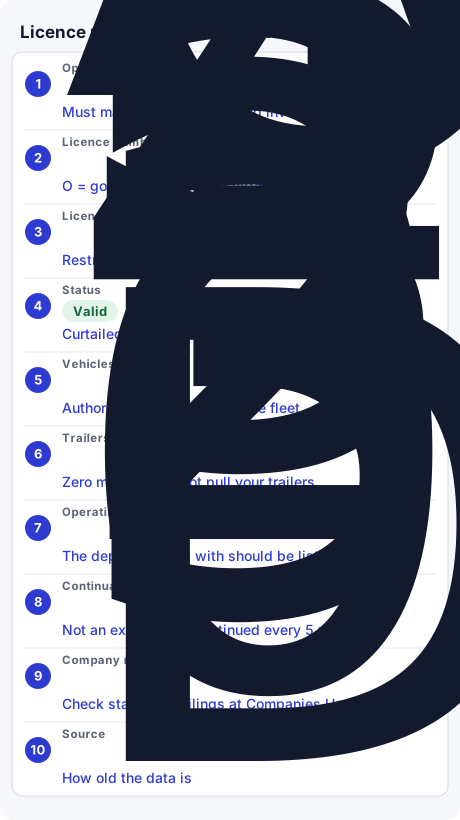
| Field | What it tells you | Red flag |
|---|---|---|
| Operator name | The legal holder of the licence | Name differs from your contract or invoice |
| Licence number | Unique ID; O = goods, P = passenger; second letter = traffic area | Number on the disc does not match the company you booked |
| Licence type | Restricted, standard national or standard international | Restricted licence for paid haulage |
| Status | Valid, curtailed or suspended | Anything other than valid |
| Vehicles authorised | The most vehicles the licence allows | Fewer than the fleet you see working for you |
| Vehicles specified | Vehicles registered on the licence now | Your lorry's registration is not on it (ask the haulier) |
| Trailers authorised | The most trailers the licence allows | Zero, when they will pull your trailers |
| Operating centres | Where vehicles are normally kept | A centre far from where they say they are based |
| Continuation date | When the 5-yearly continuation is due | A date already passed (ask; it can be data lag) |
| Company number | Companies House registration | Missing, or a different company |
Two notes. First, vehicles authorised is a ceiling, not the fleet in use. In the DVSA operator licence data, file dated 7 September 2026, 64.3% of goods licences had fewer vehicles specified than authorised (41,183 of 64,036). That gap, the "margin", is normal. Second, the continuation date is not an expiry date. Licences do not expire. They continue every five years when the holder pays the fee and confirms its details (GOV.UK).
Every standard licence must nominate a transport manager. HaulierScope does not publish transport manager, director or partner names. To check who it is, ask the haulier. The weekly Applications and Decisions bulletin names the transport manager when a licence is applied for or changed, and DVSA's open data file has a transport manager column for each licence. See transport manager CPC.
Which licence type a haulier needs to carry your goods
A haulier carrying your goods for payment needs a standard licence. A restricted licence "allows you to carry your own goods, but not other people's goods" (GOV.UK).
| Licence type | Own goods | Other people's goods for hire or reward | International hire or reward | Transport manager needed |
|---|---|---|---|---|
| Restricted | Yes | No | No | No |
| Standard national | Yes (UK or abroad) | UK only | No | Yes |
| Standard international | Yes | Yes | Yes | Yes |
This matters because restricted licences are common. In the DVSA file dated 7 September 2026, 46.2% of all GB operator licences were restricted (31,965 of 69,122). Many belong to builders, farmers and retailers who move their own stock. Holding a licence is not enough. It has to be the right type. See operator licence types for the full comparison.
Status: valid, curtailed, suspended (and why revoked licences disappear)
The DVSA open data shows three statuses: valid, curtailed and suspended. Revoked, surrendered and terminated licences drop out of the file, so they never appear as "revoked".
- Valid. The licence is in force.
- Curtailed. A traffic commissioner has cut the licence back, for example by removing vehicles, reducing the number authorised or removing an operating centre (Goods Vehicles (Licensing of Operators) Act 1995, s.26). The haulier can still operate, but with less.
- Suspended. The licence cannot be used while the suspension lasts.
In the DVSA file dated 7 September 2026, 522 licences were curtailed and 17 were suspended, out of 69,122.
When a licence is revoked or surrendered, it disappears from the next file. HaulierScope then shows the licence as "not in the DVSA file dated" that file's date. That tells you the licence has left the register, not why. To find the reason, search the traffic commissioners' Applications and Decisions bulletins. Section 7 lists licences surrendered or terminated and section 8 lists licences revoked without a public inquiry. For more detail, read curtailed, suspended and revoked licences.
Red flags
Stop and ask questions if you see any of these:
- Name mismatch. The licence holder is a different company from the one invoicing you. Licences are not transferable. GOV.UK says "a new licence for the new entity must be obtained before operating" (goods licensing guide).
- Restricted licence for paid work. The holder can carry its own goods only.
- Curtailed or suspended status. Read the decision before you book.
- Too few vehicles authorised. If three lorries turn up and the licence authorises two, at least one is outside the licence.
- No transport manager on a standard licence. Every standard licence must nominate one. Ask who it is and check the name against the Applications and Decisions notice.
- Recent changes. A new licence, a changed name or a fresh curtailment deserves a second look. Our weekly changes report lists them.
- No licence found. Search by number and by exact legal name before you conclude it does not exist. Some vehicles are exempt, but a general haulier running lorries over 3.5 tonnes will not be.
What the register does not prove
A valid licence shows the haulier is authorised to operate. It does not show:
| It does not prove | Check this instead |
|---|---|
| Goods-in-transit insurance | Ask for the certificate and check the limit covers your loads |
| Motor and public liability insurance | Ask for current certificates |
| Safety record or roadside results | Ask about DVSA checks; OCRS scores are not public |
| Financial health | Companies House filings and your own credit check |
| That a named driver is qualified | The haulier's own driver licence checks |
The Operator Compliance Risk Score (OCRS) is DVSA's risk rating for an operator. It is not in the open data and DVSA does not publish it. Operators can see their own score through DVSA's reports service (GOV.UK). Any site that shows you an OCRS for someone else's licence did not get it from the public register.
Our methodology page explains where our data comes from and how often it changes.
Other checks to run
Run two more free checks alongside the licence.
- Companies House. GOV.UK's company information service shows the registered address, date of incorporation, current and resigned officers, filed documents and insolvency information for free. You can also set up free email alerts when a company updates its details. Compare the company number on the licence with the one on the invoice. If the company is in liquidation or administration, read what happens to an operator licence when a haulier becomes insolvent.
- Insurance certificates. Ask for the goods-in-transit and motor certificates in the licence holder's name, and note the renewal dates.
For a fuller buyer's checklist, including references and payment terms, see how to vet a subcontracted haulier.
Keep checking after you book them
A check is true on the day you run it. A licence can be curtailed, suspended, revoked or surrendered next month, and nobody will tell you.
You can repeat the search before every job, or set up alerts. HaulierScope operator licence monitoring lets you add the hauliers you use to a watchlist and get a weekly email when a licence changes: status, type, vehicles authorised, operating centres, or a licence that is no longer in the DVSA file. You can also check a whole supplier list at once and download a dated record of each check for your audit file. Our data is updated when DVSA publishes a new file (the newest is dated 7 September 2026).
Frequently asked questions
Can you check if someone has an operator's license?
Yes. Operator licences in Great Britain are public. Search GOV.UK's free "Find lorry or bus operators" service by name, address or licence number, or use HaulierScope's free lookup. The record shows the holder's name, licence type, status, vehicles and trailers authorised, operating centres and continuation date. If you cannot find a licence, search again by exact legal name and by number before you conclude there is none.
Can you find out if a company has an operator's license?
Yes. Search the company's exact registered name or its licence number. A limited company's licence name should match its Companies House name, so copy the name from Companies House to avoid spelling misses. One company can hold several licences, one for each traffic area where it has an operating centre, so check that the licence you find covers the depot you deal with.
How can I find HGV operators' licences?
HGV operators hold goods vehicle operator licences, whose numbers start with O. Search by name, address or licence number on GOV.UK's "Find lorry or bus operators" service, or search HaulierScope by company name, licence number or company number. DVSA also publishes the full register as open data, one CSV file per traffic area, on data.gov.uk under the Open Government Licence.
Can I check my HGV operator licence online?
Yes. Holders can see and update their own licence through GOV.UK's "Manage your vehicle operator licence" service, which needs a login. Anyone can view the public record through "Find lorry or bus operators" without logging in. HaulierScope shows the public licence fields from DVSA's open data, updated when DVSA publishes a new file (the newest is dated 7 September 2026).
How can I check the details of a haulage license application?
Use GOV.UK's "Check vehicle operator licence applications" service, or read the weekly Applications and Decisions bulletin for the traffic area. Each bulletin lists applications received, applications decided, public inquiries, surrendered licences and revocations. Our weekly changes page summarises new and changed licences from the DVSA data.
Where can I get a free license check?
GOV.UK's "Find lorry or bus operators" service is free and official. HaulierScope's licence lookup is also free. It is independent, uses the DVSA open data and adds a history of changes from each weekly file. Paid monitoring is only needed if you want alerts or bulk checks across a list of hauliers.
What is Vosa called now?
VOSA, the Vehicle and Operator Services Agency, no longer exists. It ran from 3 April 2003 to 31 March 2014, then merged with the Driving Standards Agency to form the Driver and Vehicle Standards Agency (DVSA). Operator licensing services are now provided by the Traffic Commissioners for Great Britain, with DVSA running the administration on their behalf.
About this guide
Written and maintained by the HaulierScope editorial team. We check every fee, amount and rule against GOV.UK and legislation.gov.uk before publishing and when the rules change. Last checked 2 October 2026. HaulierScope is independent and is not part of DVSA or the Office of the Traffic Commissioner. This guide is general information, not legal advice. Read our editorial standards. Spotted an error? Tell us.
Sources
- Find lorry or bus operators (GOV.UK) (source last updated )
- Goods vehicle operator licensing guide (GOV.UK) (source last updated )
- Being a goods vehicle operator: types of licence (GOV.UK) (source last updated )
- Check vehicle operator licence applications (GOV.UK) (source last updated )
- Operator Compliance Risk Score (GOV.UK) (source last updated )
- Get information about a company (GOV.UK) (source last updated )
- Vehicle and Operator Services Agency (GOV.UK) (source last updated )
- Traffic Commissioners operator licence records (data.gov.uk)
What changed
- : Correction. The DVSA open data file is published by DVSA from its Vehicle Operator Licensing records; we no longer say GOV.UK's search draws on the same file.
- : Correction. Transport manager check: we now point to the Applications and Decisions bulletins and the DVSA open data, which name the nominated transport manager. We could not confirm what GOV.UK's search results page shows.
- : Updated. Register figures now come from the newest DVSA file automatically. Added an annotated diagram of a licence record.
- : Published. First published.
Register statistics: DVSA operator licence data, file dated 7 September 2026 (see methodology). Contains public sector information licensed under the Open Government Licence v3.0.